Introduction
In the expanding world of digital assets, alternative cryptocurrencies — known commonly as altcoins — offer a dynamic and diverse opportunity beyond major coins. For those exploring crypto‑markets through crypto30x.com altcoins resources, understanding how altcoins operate, what distinguishes them, and how to approach them wisely is essential. Altcoins vary in purpose and design: some aim to improve network speed, others focus on privacy, decentralized applications, or smart contract functionality. This complexity makes learning critical before engaging. As the ecosystem grows, readers need clarity on evaluation, risk management, and long-term outlooks. This article offers a comprehensive overview: defining altcoins, explaining their variety, examining evaluation criteria, discussing risk and volatility, outlining storage and security practices, exploring portfolio strategies, and considering the future potential and challenges of altcoins. Through clear explanation and practical insight, this guide helps both curious newcomers and more experienced participants understand what altcoins mean in a modern blockchain environment.
What Are Altcoins and What Sets Them Apart
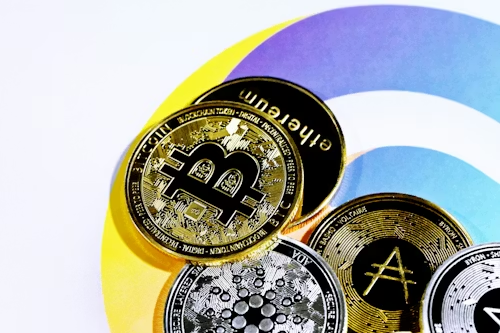
Altcoins refer to any cryptocurrency other than the original or most dominant ones. While major coins might focus on being digital currency or a compliant store-of-value, many altcoins aim for specialized functions: enabling decentralized applications, offering privacy features, facilitating tokenization, or experimenting with network governance. Their developers often seek to improve on limitations of earlier networks — such as transaction speed, scalability, energy efficiency, or more flexible contract capabilities. Because of this diversity, altcoins exhibit a wide range of characteristics. Some may be built to support decentralized finance platforms, others focused on data storage, identity verification, or supply‑chain transparency. Their design often targets niche problems, giving users specialized tools rather than broad general-purpose currency. This specialized approach differentiates altcoins from mainstream digital currencies, offering potential innovation along with higher variability in success, adoption, and usage. Recognizing these differences is critical before engaging with altcoin investments or use — and forms the basis of informed evaluation and decision-making.
How to Evaluate Altcoins: Key Criteria
Given the variety among altcoins, evaluating them requires careful criteria rather than assumptions. A first consideration is project purpose: whether the coin aims to solve a real need, offer technological improvement, or build a sustainable ecosystem. Another factor is development activity: frequent updates, transparent team communication, open-source code, and community engagement often reflect healthier projects. Supply and tokenomics also matter: total supply, distribution method, inflation or deflation mechanics, and governance rules help determine long-term viability. Liquidity and exchange support are practical elements — if a coin is rarely traded or only listed on obscure platforms, it becomes risky and harder to exit. Security audits and history of vulnerabilities can also impact reliability. Additionally, adoption metrics such as DApp usage, active users, and integrations with other platforms can signal genuine utility rather than speculative value. Using these criteria helps readers interpret altcoin potential more realistically rather than through hype alone. Crypto30x.com altcoins resources encourage this analytical approach for safer, reasoned engagement.
Risk, Volatility, and Managing Expectations
Altcoins come with elevated risk compared to more established digital assets. Because many are experimental, subject to shifting development, or dependent on small communities, their price can fluctuate wildly — both upward and downward — in short timeframes. Their utility might change, adoption may stall, or regulatory developments could affect viability. Additionally, smaller trading volumes can lead to sudden price swings. The possibility of project failure, founder exit, or technological vulnerability also exists. Given this uncertainty, expectations must be managed carefully. Crypto30x.com altcoins advice often emphasizes diversification rather than concentrated investment in any single altcoin. Beginners are encouraged to treat altcoin involvement as speculative, only allocating amounts they can afford to lose. Long-term commitment and periodic reassessment help mitigate emotional responses to volatility. Understanding that gains may come with high risk protects users from overcommitment. In a space where success stories exist but are rare and often unpredictable, caution paired with informed judgment provides a balanced pathway.
Secure Storage and Best Practices for Altcoin Holding
Because altcoins often fall outside mainstream wallets or major exchanges, securing them correctly is essential. Crypto30x.com altcoins guidance suggests careful private key management, using wallets compatible with specific blockchain standards, and verifying contract addresses before interaction. Hardware wallets or cold storage are strongly recommended when holding significant amounts. Using secure, well-reviewed wallets reduces risk from hacking, phishing, or software bugs. For tokens on less-popular networks, ensuring compatibility and checking for updates or network changes helps avoid loss. Users should also maintain backups of keys or seed phrases and avoid sharing sensitive data. For trading or interacting with decentralized applications, limiting exposure and verifying smart contract conditions minimizes risk. Overall, treating altcoin storage with seriousness—not as a casual afterthought—is essential to protecting assets in a volatile environment. Security awareness becomes a foundational component of any altcoin strategy.
Portfolio Strategies When Including Altcoins
Including altcoins in a broader digital-asset portfolio requires thoughtful strategy. One approach is balanced allocation: combining stable or major coins with smaller positions in promising altcoins to spread risk. Another is dollar-cost averaging: adding assets gradually over time rather than making large one-time purchases. Some users view altcoins as long-term speculative components — accepting volatility while holding for potential long-term utility. Others may use them for active trading, but this strategy demands discipline, market monitoring, and readiness for rapid changes. It’s also wise to periodically review holdings, track project developments, and exit positions if project fundamentals weaken. Many experienced participants treat altcoins as speculative satellites around a stable core, understanding that while a few may grow, many may remain low-volume or fade. Crypto30x.com altcoins guidance emphasizes that responsible portfolio design, combined with educated risk, helps navigate the unpredictable nature of alternative coins without jeopardizing overall financial stability.
Market Trends, Adoption Patterns, and What to Watch For
The altcoin ecosystem evolves quickly, influenced by technology advances, community interest, and broader industry trends. Periods of innovation often bring spikes in creation of new tokens, platforms, and decentralized applications. Adoption grows when real-world use cases emerge — such as decentralized finance, digital identity, asset tokenization, or supply-chain management. Media coverage and social interest can fuel short-term hype, but long-term success depends on development progress, network activity, and utility. Market cycles also affect altcoin performance: during bullish sentiment, many altcoins rally; during downturns, weaker projects often lose value sharply. Regulatory changes or technological breakthroughs can shift attention rapidly, redirecting funds and community focus. Crypto30x.com altcoins-related coverage often spotlights rising trends, emerging protocols, or shifts in developer activity as potential indicators of future movements. For participants, staying updated and discerning between hype and substance is crucial. Watching adoption patterns, community engagement, and real usage metrics helps identify sustainable opportunities rather than speculative noise.
Long-Term Outlook and Potential Role of Alternative Coins
Altcoins hold potential to shape the future of blockchain ecosystems through innovation, specialization, and flexibility. As main networks face scalability, governance, or design constraints, alternative coins can act as testing grounds for new consensus models, application frameworks, and decentralized solutions. Some altcoins may evolve into foundational layers offering services such as decentralized finance infrastructure, identity verification, data storage, or cross-chain interoperability. Long-term, this diversification could lead to a richer ecosystem where different coins specialize for different tasks, reducing reliance on single networks and distributing functionality across a web of interoperable systems. However, sustainability requires strong development communities, transparent governance, security best practices, and real-world adoption. Not all altcoins will succeed; many may fade or remain niche. But those combining innovation with stability and community support could play a meaningful role in future digital economies. For users, this means balancing optimistic potential with realistic assessment and readiness for change.
Table: Key Considerations for Altcoin Engagement
| Factor | What to Examine | Why It Matters |
|---|---|---|
| Project Purpose | Clear use case or problem solved | Helps distinguish real utility from speculation |
| Development Activity | Frequency of updates, open-source code, community engagement | Indicates long-term commitment and reliability |
| Tokenomics & Supply | Supply cap, distribution, inflation/deflation, governance | Affects long-term value sustainability |
| Liquidity & Exchange Support | Trading volume, accessible markets | Ensures ease of entry and exit |
| Security & Wallet Compatibility | Supported wallets, private key control, contract verification | Protects assets from loss or hacks |
| Portfolio Allocation | Diversified holdings, percentage of altcoins vs stable coins | Manages risk exposure |
| Adoption & Use Cases | Real-world usage, active user base, partnerships | Signals potential growth and resilience |
FAQs
What are altcoins?
Altcoins are digital coins other than the original or most dominant cryptocurrencies, often designed for specific uses, applications, or network experiments.
Are altcoins riskier than mainstream coins?
Yes. Due to variable adoption, smaller communities, and experimental design, altcoins tend to carry higher volatility and greater risk.
How should I store altcoins securely?
Use compatible wallets, preferably with hardware or cold storage, manage private keys carefully, and verify contract addresses before use.
Can altcoins offer better returns?
Potentially yes, but with higher risk. Some altcoins may deliver strong growth if they prove reliable and useful; many may not.
Should I invest a large portion of my assets in altcoins?
It’s safer to treat altcoins as a smaller part of your portfolio, balancing them with stable or well-established assets.
Conclusion
Alternative cryptocurrencies offer a wide-ranging and evolving landscape of opportunities, challenges, and innovation. Through crypto30x.com altcoins guidance, users can learn to navigate this complexity with clarity: understanding what sets altcoins apart, how to evaluate them, manage risks, and integrate them into a broader portfolio. While volatility and uncertainty remain, careful assessment, security awareness, and realistic expectations help mitigate dangers. As blockchain ecosystems continue to grow and diversify, altcoins represent both experimentation and potential. For participants who approach them with knowledge, discipline, and long-term vision, altcoins can offer unique value. For others, they remain speculative ventures. In all cases, awareness, research, and thoughtful action remain the keys to navigating the world of alternative digital coins responsibly.